
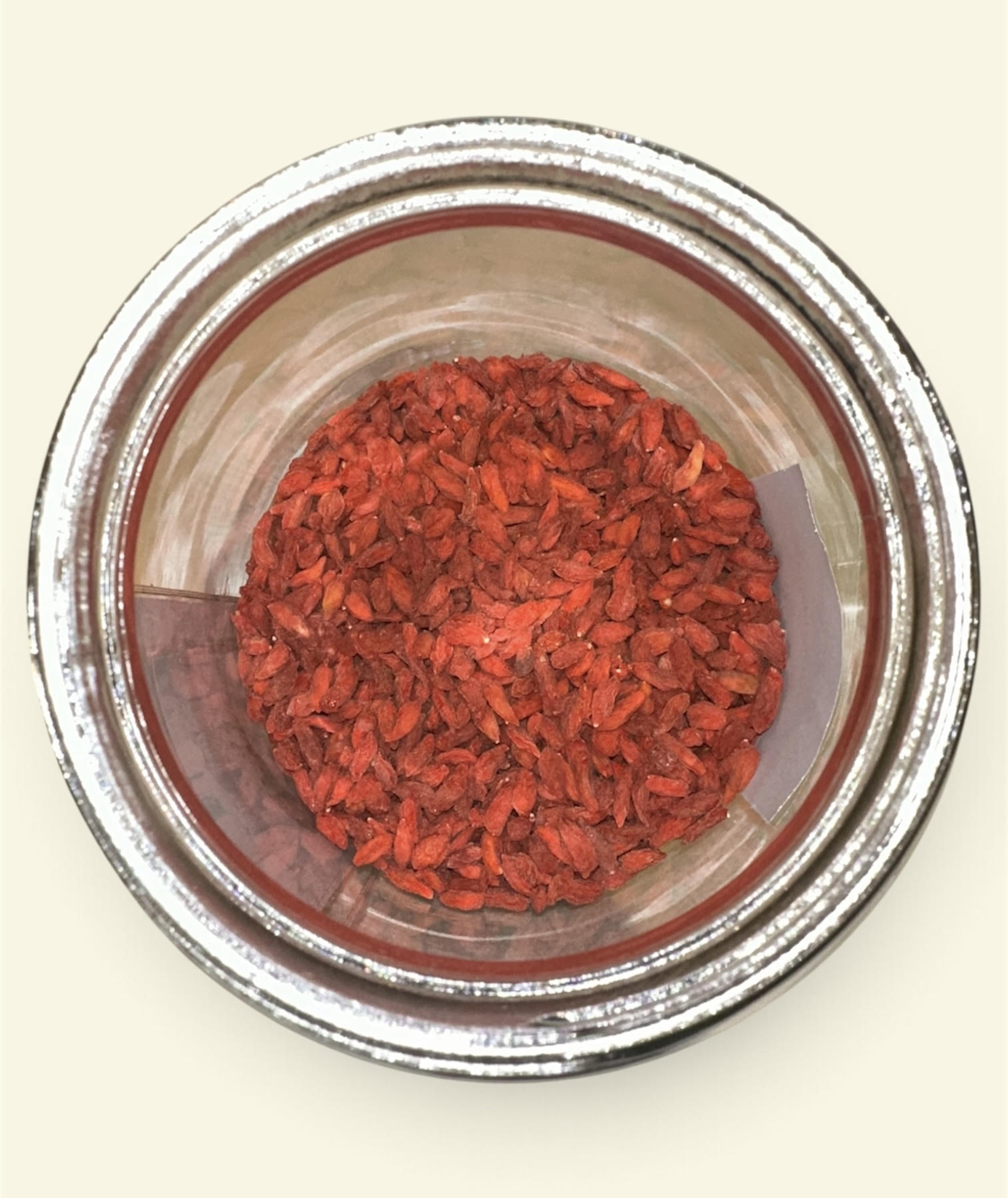
Description:
Gou Qi Zi (Lycium barbarum) is a traditional Chinese herbal medicine prepared from the dried ripe fruits of Lycium barbarum L., a plant in the Solanaceae family. It is commonly known as Gou Qi Zi, Goji Berry, Goji, Wolfberry, Chinese Wolfberry, Lycium Fruit, Fructus Lycii, and Lycium barbarum. In Traditional Chinese Medicine (TCM), Gou Qi Zi is traditionally valued for its ability to nourish the Liver and Kidney, replenish Essence, support healthy vision, and nourish Blood.
Gou Qi Zi is traditionally considered an important herb for patterns involving Liver and Kidney Yin deficiency and deficiency of Essence and Blood. It is traditionally associated primarily with the Liver and Kidney meridians and is commonly included in formulas intended to nourish Liver and Kidney Yin, support healthy vision, maintain healthy hair, and promote overall vitality.
Gou Qi Zi is traditionally used to nourish the Liver and Kidney and replenish Essence. In TCM, it may be selected in traditional formulas for dizziness, weakness, soreness or weakness of the lower back and knees, and other symptoms associated with traditional Liver and Kidney deficiency patterns.
Gou Qi Zi is also traditionally used to support healthy vision. It may be included in traditional formulas for dry or uncomfortable eyes, blurred vision, and reduced visual function when these concerns are associated with traditional Liver and Kidney Yin deficiency patterns.
Gou Qi Zi is traditionally used to nourish Blood and support healthy hair and overall vitality. It is commonly used as both a traditional medicinal herb and food ingredient in Chinese dietary and herbal practices.
Benefits:
- Traditionally used to nourish Liver Yin according to Traditional Chinese Medicine principles
- Traditionally used to nourish Kidney Yin
- Traditionally used to tonify and support the Liver and Kidney
- Traditionally used to replenish Essence according to TCM principles
- Traditionally used to nourish Blood
- Traditionally used to support healthy vision
- Traditionally used to support comfortable and healthy eyes
- Traditionally used to support healthy hair and hair vitality
- Traditionally used to support healthy skin and overall tissue vitality
- Traditionally used to support comfortable lower-back and knee function associated with traditional deficiency patterns
- Traditionally used to support overall vitality and healthy aging
- Traditionally used as a nourishing food and herbal ingredient
- Provides naturally occurring Lycium barbarum polysaccharides
- Provides carotenoids, including zeaxanthin and beta-carotene
- Provides naturally occurring polyphenols and flavonoids
- Provides antioxidant compounds investigated in modern scientific research
- Traditionally used as a nourishing ingredient in TCM herbal formulas
- Traditionally used to support overall wellness according to TCM principles
Other Names:
Gou Qi Zi, Gou Qi Zi (枸杞子), Gou Qi, Gouqizi, Goji Berry, Goji Berries, Goji, Wolfberry, Chinese Wolfberry, Chinese Goji Berry, Lycium Fruit, Lycium Berry, Fructus Lycii, Lycii Fructus, Lycium barbarum Fruit, Lycium barbarum L., and Chinese Matrimony Vine.
Persian names: گوجی بری (Goji Berry), گوجی (Goji), توت گوجی (Goji Berry), و میوه لیسیوم (Lycium Fruit).
Traditional Uses:
In Traditional Chinese Medicine, Gou Qi Zi is traditionally used to nourish the Liver and Kidney and replenish Essence. It is traditionally selected for dizziness, weakness, soreness or weakness of the lower back and knees, and other symptoms associated with traditional Liver and Kidney Yin deficiency patterns.
Gou Qi Zi is traditionally used to support healthy vision and comfortable eyes. It may be included in traditional formulas for blurred vision, dry eyes, reduced visual function, or other eye concerns when these symptoms are associated with traditional Liver and Kidney Yin deficiency.
Gou Qi Zi is also traditionally used to nourish Blood and support healthy hair. It may be included in traditional formulas for premature graying, weak hair, and other concerns associated with traditional deficiency patterns.
Traditionally, Gou Qi Zi is considered a nourishing herb that can be used regularly as part of food or herbal preparations. It is commonly combined with other TCM herbs according to the individual’s traditional pattern, constitution, and specific symptoms.
Side Effects:
Gou Qi Zi is generally well tolerated when consumed as a food or used appropriately as a traditional herbal preparation. Some individuals may experience gastrointestinal discomfort, nausea, abdominal discomfort, diarrhea, or other digestive symptoms.
Allergic reactions are possible in sensitive individuals, including those with sensitivities to plants in the Solanaceae family.
Because Gou Qi Zi contains naturally occurring bioactive compounds, concentrated extracts may have stronger physiological effects than the traditional dried fruit.
There are published case reports describing possible interactions between goji products and warfarin, so individuals taking anticoagulant medication should exercise particular caution.
Discontinue use and consult a healthcare practitioner if unwanted or persistent symptoms occur.
Precautions:
Consult a healthcare practitioner prior to use if you are taking prescription medications or other natural health products, or if you have a medical condition.
Consult a qualified healthcare practitioner or Traditional Chinese Medicine practitioner before use if you are taking anticoagulant or antiplatelet medications.
Individuals taking warfarin should consult their physician or pharmacist before using Gou Qi Zi because possible interactions with warfarin have been reported in the scientific literature.
Consult a healthcare practitioner before use if you are taking medications for blood pressure, blood sugar, or other chronic conditions.
Individuals with known allergies to plants in the Solanaceae family should use caution.
Do not use during pregnancy or breastfeeding unless directed by a qualified healthcare practitioner or Traditional Chinese Medicine practitioner.
Consult a healthcare practitioner before use if you have a serious or major medical condition.
Discontinue use and consult a healthcare practitioner if symptoms persist or worsen or if new symptoms develop.
Interactions:
Consult a healthcare practitioner before using Gou Qi Zi with prescription medications or other natural health products.
Human clinical interaction data for whole dried Gou Qi Zi are limited. The potential for interactions may vary according to the preparation, dose, duration of use, and concentration of active constituents.
Warfarin and anticoagulants: Published case reports have described possible interactions between goji products and warfarin, including changes in anticoagulant effect. Individuals taking warfarin should avoid self-directed use and consult their physician or pharmacist.
Blood-pressure medications: Goji and its constituents have been investigated for cardiovascular and vascular effects. Individuals taking blood-pressure medication should seek professional guidance before using concentrated preparations.
Blood-sugar medications: Lycium barbarum polysaccharides have been investigated for effects on glucose metabolism. Individuals taking glucose-lowering medications should monitor appropriately and seek professional guidance.
Antiplatelet medications: Because potential effects on cardiovascular and coagulation pathways have been investigated, professional guidance is appropriate when combining concentrated Gou Qi Zi preparations with antiplatelet medications.
Individuals taking multiple medications or combining Gou Qi Zi with concentrated herbal extracts should consult a qualified healthcare practitioner before use.
Dosing:
Use according to the product label or as directed by a qualified healthcare practitioner or Traditional Chinese Medicine practitioner.
Traditional Chinese Medicine references commonly describe Gou Qi Zi in an approximate range of 6–15 g when used as a dried fruit or decoction, although the appropriate amount depends on the preparation, formula, individual constitution, and clinical circumstances.
Because Gou Qi Zi is also traditionally consumed as a food, amounts used as food may differ from therapeutic herbal preparations.
For a 50 g bulk-herb product, the package quantity should not be interpreted as a recommended daily dose.
Storage:
Store in a cool, dry place away from direct sunlight. Keep tightly closed and out of reach of children.
Because dried goji berries can absorb moisture, keep the package well sealed and protected from humidity. Discard if there are signs of mold, unusual odor, insect contamination, or spoilage.
Preparation:
If using dried Gou Qi Zi, prepare according to the directions provided by your Traditional Chinese Medicine practitioner or product instructions. Traditionally, Gou Qi Zi may be eaten directly as a dried fruit, soaked in warm water, added to teas or soups, or prepared as part of a TCM herbal formula.
Gou Qi Zi may also be combined with other herbs in traditional decoctions according to the individual’s TCM pattern and intended use.
Scientific Support:
Gou Qi Zi is primarily derived from the dried ripe fruit of Lycium barbarum L. The fruit contains naturally occurring polysaccharides, carotenoids, phenolic compounds, flavonoids, vitamins, betaine, and other phytochemicals. Lycium barbarum polysaccharides (LBPs) are among the most extensively studied constituents of the fruit.
Modern research has investigated Lycium barbarum and its polysaccharides for potential antioxidant, anti-inflammatory, immunomodulatory, neuroprotective, hepatoprotective, metabolic, and eye-related biological activities. These findings provide scientific interest in Gou Qi Zi but do not establish that whole dried goji berries are effective for treating specific medical conditions in humans.
A systematic review of Lycium barbarum polysaccharides identified experimental and clinical research involving potential effects on oxidative stress, inflammation, liver-related conditions, metabolic health, and other biological processes. The review also noted the need for larger, better-designed human clinical trials and improved standardization of the studied preparations.
Research has also investigated Lycium barbarum polysaccharides in relation to glucose and lipid metabolism. A systematic review and meta-analysis reported potential effects on triglycerides, fasting blood glucose, LDL, and HDL in the studies analyzed, although the evidence concerns specific polysaccharide preparations and should not be automatically applied to a 50 g whole-fruit product.
Goji berries are also a significant source of carotenoids, particularly zeaxanthin and beta-carotene. Research into Lycium species has examined their nutritional composition and potential role in supporting eye health and antioxidant protection.
Clinical evidence for Gou Qi Zi remains variable compared with its long history of traditional use. Research differs according to the fruit species, cultivation, processing method, extract, dose, and health condition studied. Additional high-quality human clinical studies are needed to establish specific therapeutic applications, effectiveness, safety, and dosing.
References & Scientific Support:
PubMed – Goji (Lycium barbarum and L. chinense): Phytochemistry, pharmacology and safety in the perspective of traditional uses and recent popularity. This review specifically examines goji fruit, including Lycium barbarum, its traditional uses, phytochemical constituents, pharmacological research, and safety considerations, including reported potential interaction with warfarin. View Research.
PubMed – A Systematic Review of Potential Therapeutic Use of Lycium Barbarum Polysaccharides in Disease. This systematic review examines research involving Lycium barbarum polysaccharides, including antioxidant, anti-inflammatory, neuroprotective, metabolic, liver-related, and other potential biological effects, while noting the limitations of current human evidence. View Research.
Health Canada – Licensed Natural Health Products Database: Goji Organic. This Health Canada record identifies Lycium barbarum as a medicinal ingredient and specifically states that Goji is traditionally used in Traditional Chinese Medicine to nourish the Liver and Kidney, replenish Essence, and improve vision. The record also provides Canadian cautions concerning pregnancy, breastfeeding, prescription medications, and allergy to the Daisy family. View Research.


